We shared Dr Chloe Sharp’s ideas on fast and slow research several weeks ago. It’s a great way to think about how you conduct your research. Check out the post: https://lnkd.in/g4FcnNa9
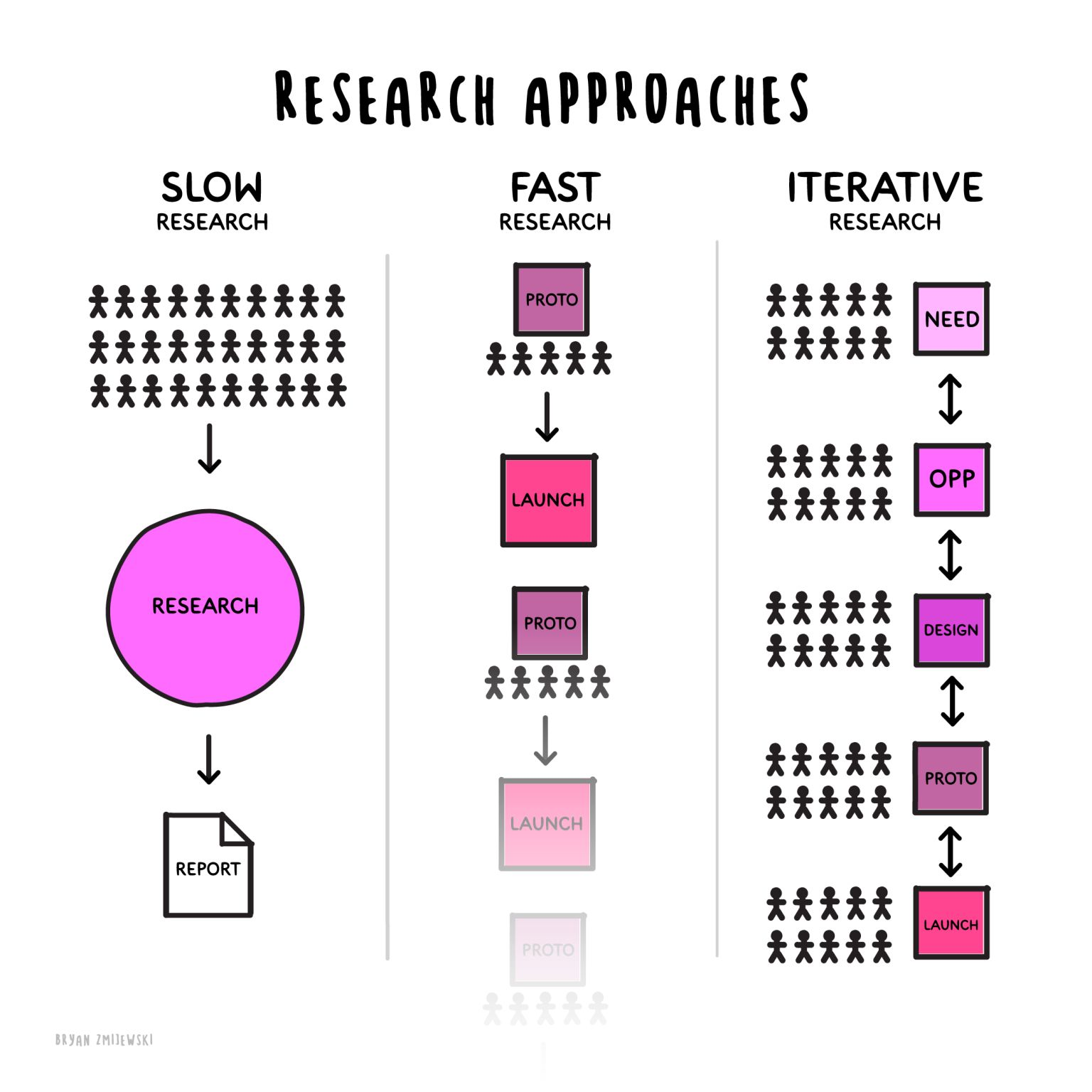
Here’s how she breaks down slow and fast research:
→ Slow Research
This approach focuses on deeply understanding customers' and users' needs. It's centered around identifying problems using early-stage, hypothetical concepts to achieve a problem-solution fit and make informed strategic decisions.
The process incorporates qualitative research, such as interviews, and quantitative methods, like surveys. It also involves a lengthy feedback loop, where data is collected and analyzed to refine problems and develop solutions continuously.
→ Fast Research
This approach begins by developing prototypes or an MVP, where ideas have evolved, and the focus is now refining the problem-solution Fit. Prototypes and MVPs prove how well a product meets market demands.
Feedback during this stage is more targeted, and experiments are conducted to gather insights quickly. Updates to the product are made swiftly. Lean UX and Agile methodologies emphasize incorporating user feedback during brief, intensive periods.
💡 A third way is to structure your research in cycles that sync up with different phases of the product design process. This method combines fast and slow research elements, allowing you to adapt and make informed decisions as your ideas evolve. Research is a supportive backbone throughout product development, carrying an audience alongside design decisions. Helio makes this happen for our team and customers.
→ Iterative Research
This approach emphasizes continuous improvement through repeated cycles of testing and refining ideas. The primary goal is incrementally enhancing the problem-solution fit, with each iteration based on previous learnings. Throughout this process, various opportunities, prototypes, or features are developed, tested, and either accepted, modified, or discarded based on user feedback.
Feedback is iterative, allowing for rapid adjustments and learning. It often leverages lean or agile methods (we use Progressive Design), ensuring that development is responsive and flexible to changes based on real user experiences. This cycle of development, feedback, and revision helps fine-tune the product to meet the market's needs better.
How does your company perform research?
Let's connect!
Find me here:
 Bryan Zmijewski